
Revolutionizing Business Communication through Cloud Calling

Today's fast-paced digital business world is not constrained by the confines of a phone system. Today, companies look to smarter, quicker, and more connected solutions to enable their teams to engage customers across the various channels seamlessly. It's here that Aircall has come into play as a leading cloud communication provider.
Aircall is a cloud phone and customer communication platform for modern sales and support teams. Businesses can use Aircall to handle calls, texts, customer conversations, and analytics from their laptops or mobile devices, instead of relying on cumbersome, hardware-based systems and old office phones. Its intuitive interface, seamless CRM integration, AI capabilities, and scalability make it a favored choice for businesses of all sizes.
What Is Aircall?

Aircall is a cloud-based Voice over Internet Protocol (VoIP) communications platform that is designed for primarily customer-facing teams. The company was launched in 2014 in Paris and is rapidly expanding, serving thousands of businesses around the world today. It is designed to make business communication easier, bringing together calling, messaging, customer insights and automation in a single platform.
Aircall is a cloud-based (not on-premises) phone service, meaning you don't need to install any hardware or hire a technician. Companies can configure calls, establish teams, and track performance in a matter of seconds – no complex installations required. This versatility has made the platform particularly appealing to remote workers, startups, customer service teams, and sales teams.
Key Features of Aircall

Aircall's popularity is due to its numerous modern communication options. The platform offers more than just a call-handling solution, offering businesses tools that enhance the customer experience and boost team productivity.
1. Cloud-Based Calling
Aircall provides companies with local, toll-free, and global telephone numbers from various nations. Call handling is possible from anywhere with teams using desktop or mobile applications. Since it is cloud-based, workers can stay in touch with customers while disconnected from the office.
2. Data Quality Rules and Data Quality Profiles
A key advantage of Aircall is its integration capabilities. It integrates with over 100 business tools, such as CRM software, helpdesk, productivity and automation platforms. Some popular integrations are Salesforce, HubSpot, Zendesk, and Slack. These integrations can help businesses log calls automatically, retrieve customer information on the fly and streamline workflows.
3. AI-Powered Features
AI is a crucial aspect of contemporary communication channels, and Aircall has made significant efforts in this area. AI-powered call summary, conversation intelligence, keyword tracking, and sentiment analysis provide businesses with insights into customer interactions. AI-powered insights enable managers to analyze calls instantly, discover patterns, and enhance team performance.
4. Call Monitoring and Analytics
Ensure that the business can view and analyze incoming calls.
Aircall also provides a range of advanced analytics features that enable managers to track call activity as it happens. Businesses can monitor missed calls, response time, call duration, etc. and agent productivity. The insights gained from these help teams to optimize customer support operations and enhance service quality.
5. Business Messaging
Apart from voice calling, Aircall can support SMS, MMS, and even WhatsApp calling in certain areas. By using this omnichannel strategy, businesses can connect with their customers through the channel of their choice, providing a more personalized experience.
Why Businesses Opt For Aircall
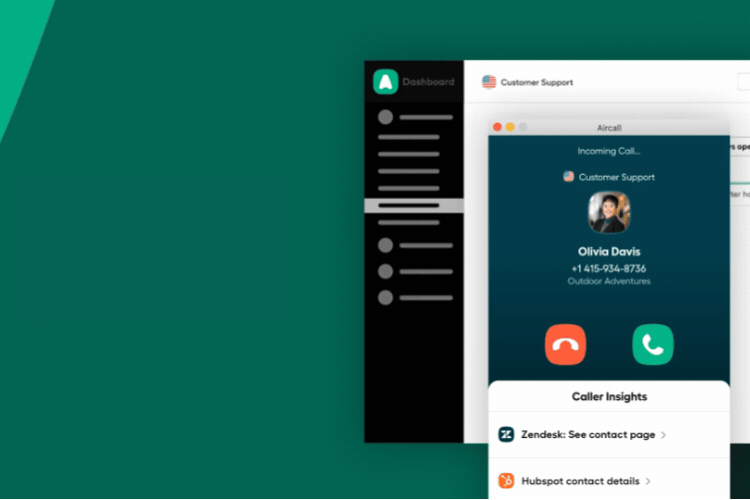
Legacy phone systems are not as flexible or as capable of integration into a modern business, so it is becoming more common for businesses to move away from them. Aircall addresses these challenges with an easy-to-deploy, scalable and collaborative communication platform.
Aircall also streamlines the response time and customer satisfaction for customer support teams. Shared inboxes, call routing, IVR menus and call tagging will help you direct customer inquiries to the right department in a timely fashion. Power dialing, call recording, and workflow automation are also features that help sales teams be more efficient and reach out to more people.
One of the other big benefits is the fact that it can be used remotely. Aircall is completely web-based, which means that teams can collaborate remotely without any hassle. This was especially beneficial in the transition to remote and hybrid work environments across the globe.
For Customer Support Teams, try Aircall

One of the biggest industries in which Aircall will excel is the customer support sector. For companies that receive a great deal of customer inquiries, it's essential to have a solid communication system that can efficiently organize the conversations.
Aircall's shared call inbox enables teams to work together on customer issues without losing valuable context. The ability to live monitor calls, coach agents, and review calls for training. AI-generated summaries also save agents time from having to take notes.
The integration with other CRM systems allows support agents to easily access customer history while on the phone. This makes the communication smoother and helps to enhance customer satisfaction as well.
Aircall for Sales Teams

The speed and efficiency of communication are crucial for sales teams. There are a number of features in Aircall that can help enhance outbound sales performance.
Power Dialer lets agents make calls without having to dial phone numbers. You can save time with automated voicemail, which sends pre-recorded messages instantly. Call performance analytics can also help managers determine which sales strategies are effective and what they can do to enhance the conversion rate.
The platform's CRM integrations are especially beneficial for sales teams, as they save them the time of manual data entry. Customer interactions with them are automatically synced with CRM systems, which means that there are accurate records and streamlined follow-up.
Aircall’s Growing Global Presence

Aircall has since grown rapidly in both sales and market share in foreign territories. It now has offices in several countries around the world: Paris, New York, London, Berlin, Madrid, Sydney and Seattle. It is utilized by over 20,000 businesses globally and is still expanding at a rapid pace in the competitive cloud communications market.
The company has also been a favourite of investors for many years. The ability to secure funding rounds and expand further signifies confidence in Aircall's long-term growth and success as a top business communication solution.
Challenges and Limitations
While Aircall has numerous benefits, it also has some drawbacks. However, the site has been reported to be somewhat costly as compared to some others, particularly for small businesses with tight budgets. Others have pointed out possible integration problems if there are other tools involved that are not compatible.
Also, Aircall is not as video-heavy as some of its competitors are, with a greater emphasis on voice communication and CRM integration. For businesses who want a single solution for collaboration, they might choose other options that have built-in video meeting functionality.
Yet, despite these worries, a lot of organizations opt for Aircall for its advanced call management capacities, ease of use, and contemporary cloud-based structure.
Cloud Communication for the Future

AI, automation, and multi-channel customer engagement take the center stage in the future of business communication. What companies want are platforms that integrate calls, messaging, analytics, and customer intelligence into a single, unified experience.
Aircall looks set to be one of the future's winners in this regard. The company is also investing in AI-powered tools, workflow automation, and customer intelligence, which are testament to its commitment to innovation. Cloud communication tools like Aircall will likely be even more critical for companies all over the world as more people work remotely and sell goods online, as well as support customers through remote channels.
Conclusion
Aircall has proven itself to be a modern communication solution for today's businesses. The company's cloud-based solution helps businesses to communicate more efficiently, collaborate more effectively, and provide better customer experiences than ever before.
With its VoIP calling, CRM integration, AI-driven analytics, and remote work capabilities, it's a solid option for customer support and sales professionals. Though it's not the best idea for every organization, its rising popularity shows the need for more and better connected and intelligent communication systems.
In an increasingly digital-centric world, Aircall will undoubtedly have a significant impact on the future of customer communication and business collaboration.


Comments