
The World's Most Unusual Border Towns

The national border is typically thought of as a line on a map, with checkpoints, fences or a change in the road signs. In other places, however, borders traverse streets, separate neighbourhoods or establish towns where two countries become a way of life. There could be a legal system in one part of a country and another in another, and a house, café or public square might be unusually close to an international boundary.
These locations are the interesting aspects of Geography. They show how history, politics and local identity influence everyday life and how communities react to the introduction of an international line into their environment. For travellers who are interested in places that defy the conception of borders, these towns tell stories much deeper than a picture by a border marker.
Baarle is a border within the Town
Bordered by Belgium and the Netherlands, the town of Baarle is the most unusual border town in the world! The municipality of Baarle-Hertog is surrounded by the Netherlands, but contains a number of small enclaves within it. Further, there are enclaves of Belgium inside of some parts of the Netherlands, forming a complex web of international borders within the town.
Areas of special marking on pavements guide visitors through streets and areas. In some buildings, the border runs through the property and the next factor to consider is where the main entrance of the building is. This settlement was based on medieval land deals, and has been preserved across centuries of territorial shifts.
The odd geography has now become the town's identity. In just a few minutes one can cross the border between Belgium and the Netherlands, but the settlement is more than a geographical curiosity. People still live, work and run businesses there, and deal with administrative arrangements that are influenced by the border. Baarle illustrates the informal nature of historic agreements that can turn into an everyday routine.
Gorizia and Nova Gorica: One City, Two Countries
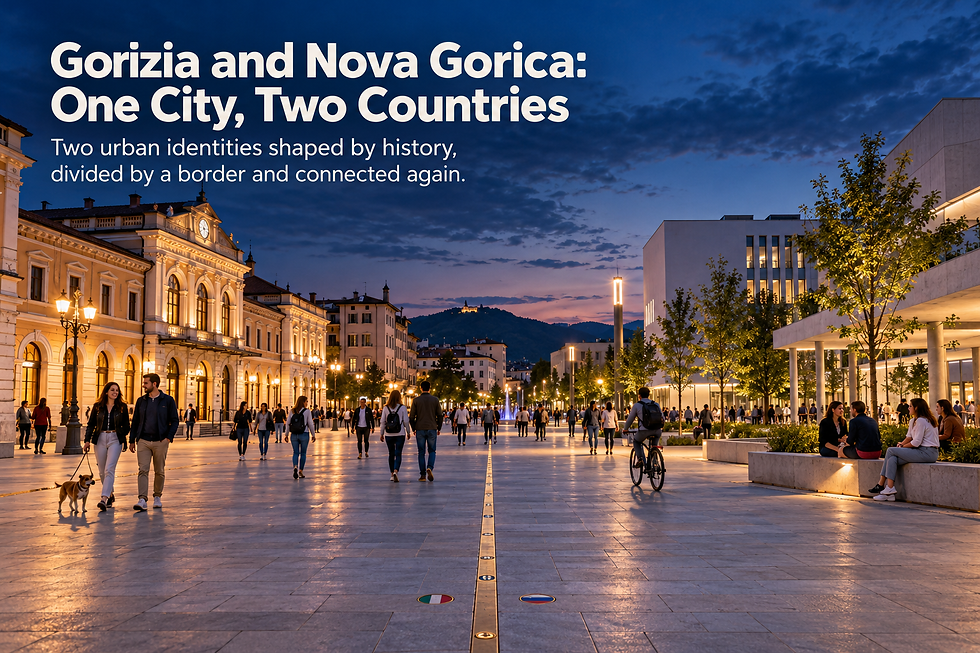
Bordered by Italy and Slovenia, Gorizia and Nova Gorica illustrate the impact of political boundaries on an urban landscape. Gorizia was a historic city and Nova Gorica was constructed following the end of the second World War, when the new border was located in the surrounding area of Gorizia and much of it fell into Yugoslavia.
Over the years, the border has symbolized strong political opposition. The separation caused families to be separated, transport routes were interrupted and local connections suffered. Since Slovenia joined the European Union and the Schengen Area, there has been a lot of ease in cross-border travel between the two countries.
The cities today provide contrasting but linked experiences. Gorizia boasts historic streets and architecture that have been influenced by several hundred years of Central European and Italian history. The town of Nova Gorica has a more modern urban design, with large green spaces and buildings from the post-war era.
They demonstrate together how an international border can generate different identities, but also communities across the border sharing cultural and economic ties.
Valga and Valka: Life Across Two Countries
The natural state of Valga (ESTONIA) and Valka (LATVIA) is one contiguous urban area in northern Europe. The international border runs through a community whose streets and social networks date back to before the modern day border was established.
Estonia and Latvia subsequently entered into European systems for free travel across their borders, making movement across the two sides easier. People living in the area were able to go for work, shopping and social visits without it being a big international trip.
The towns have their own administrations and national identities, but are sufficiently close that cooperation is encouraged. It's a place to watch the mundane everyday functions take place across an international line for visitors. Various road signs, public services and administrative systems share an urban space.
Valga and Valka bring cross-border cooperation to life. They prove that the borders can still be politically relevant without being barriers to daily life.
Nicosia: A Capital Divided

The story of Nicosia, capital of Cyprus, is more sensitive. Since the conflict of the 1970s, the city has been divided, with a buffer zone maintained by the UN between the Greek Cypriot south and the Turkish Cypriot north. The division is still a physical facet of the city, and movement between the two sides is facilitated with crossing points.
The historic center features narrow streets, traditional markets, and religious structures and buildings, which are a testament to the centuries of cultural exchange. However, there are some roads that terminate at barriers and buildings inside the buffer zone are still abandoned or inaccessible. These spaces highlight the potential of conflict to disrupt urban life and to engrave a lasting mark on the urban fabric.
It's not just a place to see an odd border, Nicosia is. Its division is related to displacement, personal history, and ongoing political issues. The subject should be approached sensitively and in accordance with current crossing requirements, while respecting restrictions on crossing controlled areas.
The city illustrates how borders can be more than just geographical. They may also signify unsolved conflicts, or lives that have been influenced by separation.
Derby Line and Stanstead: A Border Through a Building
An international border that runs through buildings and public spaces is a feature of neighbouring communities in the United States and Canada, Derby Line and Stanstead. One is the Haskell Free Library and Opera House. It was constructed on both sides of the border and designed to benefit the people in both nations.
It has now become a symbol of cultural cooperation and how a common building can unite communities across national borders. Its location allows visitors to enjoy the unique interplay of architecture and geography.
But with today's security needs, the building can no longer be considered an unguarded "shortcut" between countries. It is subject to official entry and movement procedures and visitors may need to refer to current regulations before visiting.
The surrounding towns have a more peaceful image of an international border than do the urban crossings with heavy volumes of traffic. In this case, the border is an integral part of local geography, with varying degrees of practical impact depending on the law that is enforced.
The Spanish town of Llívia is encircled by France
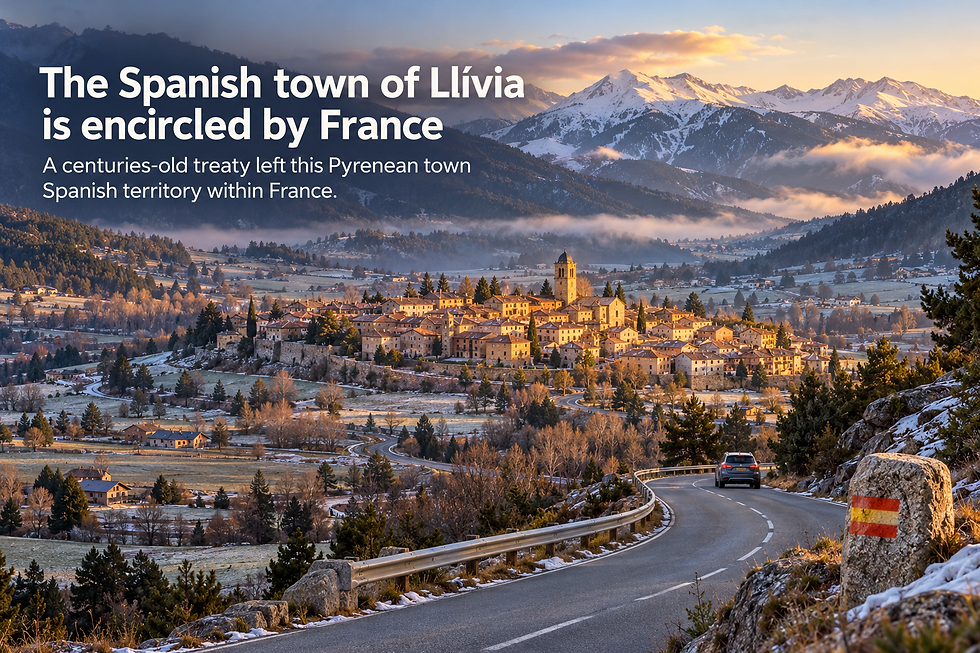
Llívia is a Spanish town, surrounded by French land, in the Pyrenees. It is unique because of a treaty in the 17th century, which handed over neighbouring villages to France and kept Llívia, which has the legal status of a town, under the rule of the Spaniards.
This is a settlement which geographically is surrounded by France, but politically is part of Spain. It is accessible from the road passing through French territory, and is surrounded by the mountains, which enhance the journey.
Llívia's story is how the legal language and the context of history has influenced geography. The town is not an especially recent addition made by a mapmaker, but a product of centuries old negotiations.
It has a fascinating history and is located on the border of the south-west of Europe, so it is an interesting place to visit on your travels. It also shows that the borders of the world are not necessarily the ones that one would expect, based on geography.
More Than a Line on a Map
The unusual border towns show that there are many sources to international borders. Some came about in the Middle Ages from land ownership; some from wars and political borders; some from treaties that put settlements on the wrong side of a border.
A border can impact on taxation, schools, shopping, public services and address registration for residents. It may barely be felt on a normal day or it may serve as a reminder of a challenging past. These differences are of interest to visitors as a means of comprehending the effect of political decisions on local life.
The concept of a country as a well-defined area is also undermined by border towns. Even with different governmental systems, languages, family connections and food habits can cross lines. Identities can be shared, layered or contested, with a street belonging to one country and the next.
What is the best way to visit Border Towns with respect?

It takes more than a boundary marker to explore these destinations. Travelers are advised to verify entry requirements, hours and local regulations, including controlled areas or border checks. Not all crossings are allowed on an open street.
It's also crucial to keep in mind that these locations are homes, not outdoor exhibits. The borders might be charged with political tension, daily hassles, or family history, and residents might have strong feelings about their borders. Signs are to be followed, intrusive photography is not permitted and local experiences are sensitive and should be recognised with respectful behaviour.
Local museums, guided walks and community information can be helpful for background context. The reason for the border or what it means to people today can make a visit more rewarding than a trip in which one stands in two countries at once.
Discovering the World Between Countries
The world's unusual border towns reveal that as much as mountains, rivers and coastlines, geography is a product of human choices. The limits may separate buildings, link city centers or isolate a community within another nation.
These are not just geographically new destinations for the traveller; they are also culturally enriched and provide for spiritual renewal. They expose the processes of identity formation, the normalisations of everyday life under changing politics, and the negotiation of the bordering of communities. Visiting the border might be the motivation, but experiences with the people, the history and the daily life surrounding the border make the trip worthwhile.


Comments