
The new travel flex is offering more time rather than more money

There was a long time when luxury travel was simply a matter of how much money you can throw around. The five-star hotel. The business-class seat. The private villa. The unreserved restaurant. But it's about to change. For many people who travel these days, the greatest luxury is they become something which money can hardly afford: time.
Three weeks to visit a country: a luxury that doesn't exist. Three weeks to visit a country – a luxury that doesn't exist. Spending time in one city so as to know the neighborhood instead of passing through the landmarks. Making use of a Tuesday morning flight, instead of packing a holiday into a public holiday weekend.
The new travel flex doesn't necessarily mean more money available. It's taking time to really enjoy the place you're going to!
From seeing everything to experiencing something
There are so many different ways to document a trip, but sometimes so few ways to do it.
The typical holiday is like a race. Get up very early, go to a landmark, take pictures, check in to another hotel, go to the next restaurant, take the next train, check in to yet another hotel, go to the next restaurant, take the next train, repeat, etc. When you arrive at the end of your trip, you might have visited 10 locations and had no idea that any of them were there. Slow travel is another way of doing it.
Travelers, rather than asking “how many places can I visit?” are shifting their focus to asking “how much of one place can I actually experience?”
This may be because one week's stay in a small coastal town may be preferable to five city visits. It could mean using the train as opposed to an airplane between destinations. This may mean going to the same café each morning until they know you. Itinerary is not as important as experience.
The Rise of Longer Stays

Besides, there's a real reason that travel time is more appealing: work has changed. Thanks to the flexibility of working remotely, some are now able to work from places they once could only visit on holiday, such as freelance jobs or teams that are distributed around the world. It doesn't have to be two weeks off work to get two weeks away, either.
For individuals who are able to work at home, a vacation can be a longer stay. A month in Spain. Several weeks in Japan. A season in Portugal. A season in Portugal. A couple of weeks of being a bit more free from the constraint of the calendar in Southeast Asia.
This alters the work-travel dynamic. People can sometimes do the opposite and embrace travel rather than trying to get away for a few days.
The bus drivers I know enjoy their job the most when they are busy. I know a lot of bus drivers who like their job best when they are busy.
A short journey isn't necessarily a bad thing
The issue is the need to maximise every journey. Every hour counts when you're out there for 48 hours only. Pressure to visit the famous attraction, eat at the famous restaurant, take the perfect photo and visit the famous neighbourhood. Longer stays means breathing room.
Time to have a lazy morning. You can be stuck in the rain without feeling like your whole trip has come to a breaking point. Can go back to somewhere you enjoyed. You may change your plans if you find that you want to do something different. Imperfection of travel time is an advantage of time.
Sometimes those moments aren't perfect and they're the ones you're going to remember the most.
The Social Media Effect

There's another reason for this move to be important. For years, the web has been rewarding the move of travel culture. New destination. New hotel. New airport. New photograph. New itinerary.
The result is an unusual journey one-on-one game where the more places you've been the more you are. But it's also bringing about the reverse reaction through social media.
There are more visitors thinking about the necessity of having a trip look impressive to be meaningful. A quiet breakfast, an empty beach, a stroll through a residential area or an afternoon of doing nothing may not garner the most likes but it will make a much better holiday.
The ideal trip is losing popularity to something much simpler: No Place Else But Here.
The concept of luxury has evolved over time
Since the dawn of time, luxury has always been tied to rarity. Money was the thing that was scarce for a long time. For many today, it's time. You can afford a superior hotel room. A flight upgrade is available. There are opportunities to book a private experience. However, you can't just buy another week of your life. Which is why it's better to travel slowly and enjoy the luxury of the journey than to spend thousands on a crammed holiday.
Think about how it's an experience of being somewhere and immediately not thinking about getting there. This perception of luxury is becoming part of the feeling itself.
The New Traveler Wants Less From a Trip
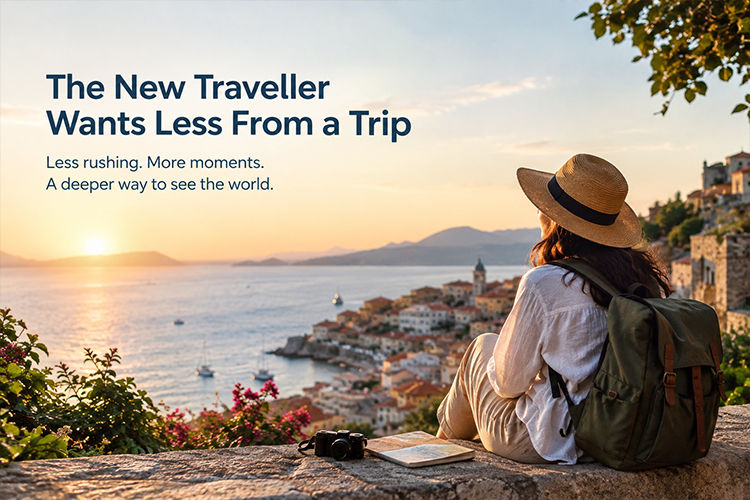
Surprisingly, the more time the trip takes doesn't correspond to the amount of work performed. It could be a sign of doing less.
Less rushing. Reducing the number of checks off attractions. Reduced transfers between hotels. Not so anxious about whether you're making the best of each day. Rather it could be fewer alarms, more interactions with locals, more random finds, more time spent just being where you are.
The quandary is that the longer you remain, the less you might feel compelled to show your presence. When you have time to walk down the street twice, you do not need to take pictures of each street.
Is Slow Travel the Future?
Not for everybody and not necessarily so. There are some travelers who have a preference for tight itineraries. Others do not have a lot of vacation time. Others like to visit as many places as they can.
However, the increasing popularity of the longer/softer journey is more than just a travel fad. Individuals are realizing that they are spending increasing amounts of time.
Optimising productivity, maximising schedules and filling calendars for years now, there is an increasing allure in doing the opposite when travelling: creating space.
Travel isn't necessarily an escape from your life.
At times, it can be an opportunity to experience life at another speed.
A traveler's dream is not necessarily a luxurious one

When someone asks you, "Where are you going on vacation next time?," maybe the more interesting answer is not "where".
What it's about is the length of your stay.
Because anyone who has the money can book a flight!
But to be able to stay a bit longer, take the slower road, alter plans and just put down in a place that's another kind of wealth.
Maybe this is the direction of travel.
Not to go for more.
Not towards spending more.
But towards an increase of time to be there.


Comments